For South African firearm owners facing ever-increasing ammunition costs and periodic supply shortages, reloading your own ammunition offers significant financial savings and the ability to customise loads for your specific firearms. Whether you’re a competitive shooter at the Bisley range in Gauteng, a hunter preparing for the bushveld, or simply want ammunition independence, reloading can be both practical and rewarding.
Understanding the Legal Framework
Before purchasing equipment, understand South Africa’s legal requirements. You must hold a valid firearm licence for the calibre you intend to reload. Store components – particularly gunpowder – according to SAPS regulations. Powder must be kept in approved storage separate from primers and projectiles. Familiarise yourself with the Firearms Control Act requirements, as improper storage can result in licence revocation. Join organisations like SAGA (South African Gunowners’ Association) for guidance on compliance.
Essential Equipment Investment
Starting reloading requires upfront investment, but costs are recovered relatively quickly. A single-stage press like the Lee Classic Cast or RCBS Rock Chucker is ideal for beginners, costing R2,500-R4,000. These presses handle one cartridge at a time, promoting careful attention to detail while learning.
You’ll need calibre-specific dies (R800-R1,500), which resize cases, seat bullets, and apply crimp. A powder scale – either beam-type (R600-R1,200) or digital (R1,500-R3,000) – is critical for safety. Never estimate powder charges. Add a powder measure (R1,000-R2,000), case trimmer (R800-R1,500), and calliper (R400-R800) for measuring case length and overall cartridge dimensions.
Budget R8,000-R12,000 for a complete starter setup from South African suppliers like Frontier Distributors, Magnum Supplies, or local reloading shops. This investment typically pays for itself after 500-1,000 rounds depending on calibre.
Components and Sourcing
Reloading requires four components: brass cases, primers, powder, and projectiles. In South Africa, sourcing can be challenging. Local suppliers stock popular calibres like 9mm, .223 Remington, and .308 Winchester more reliably than obscure chamberings. Expect to order in advance and buy in bulk when available.
Brass cases can be reused multiple times – collect your fired cases at the range. Primers are often the scarcest component; buy them whenever available. Powder selection depends on your calibre and intended use. Popular powders like Somchem S321 (for pistol) and S365 (for rifle) are locally manufactured and generally more available than imported brands.
The Reloading Process
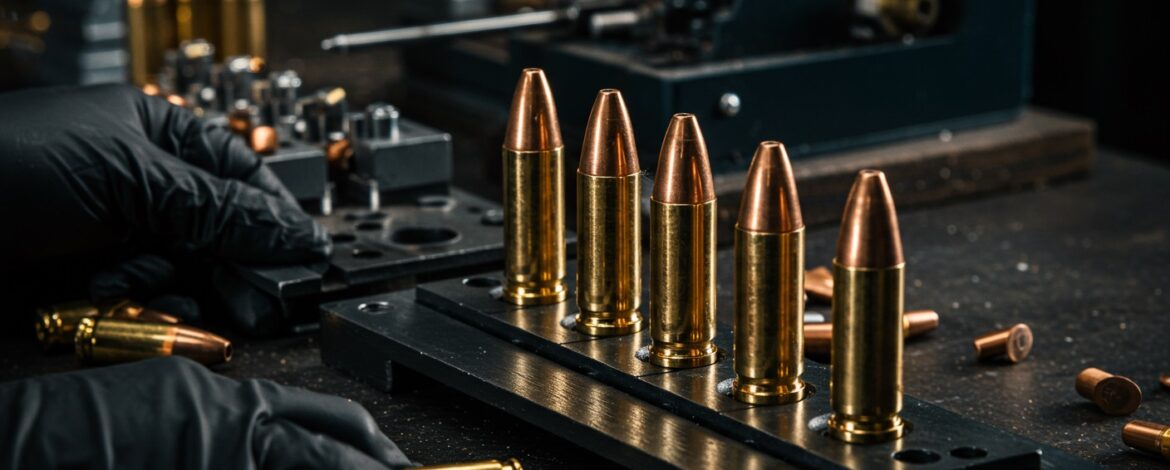
Reloading follows a systematic process: inspect and clean fired cases, resize and deprime, trim cases to proper length, clean primer pockets, prime cases, charge with powder, seat bullets, and crimp if required. Each step demands attention – reloading isn’t something to do while distracted.
Start with published load data from reputable sources like the Somchem reloading manual, Hornady handbook, or online resources from powder manufacturers. Never exceed maximum recommended loads. Always start at minimum charges and work up carefully, watching for pressure signs.
Safety Above All
Reloading safety is paramount. Work in a dedicated, well-lit space free from distractions. Never smoke or have open flames near powder. Label everything clearly. Keep a detailed logbook recording components and loads. Store powder and primers separately in cool, dry conditions away from heat sources.
Double-check every powder charge. A rookie mistake – double-charging a case or using the wrong powder – can destroy firearms and cause serious injury. Develop consistent habits and never rush.
Community and Learning
Join local reloading clubs or forums like SA Gunclub or Accurate Reloading’s South African section. Experienced reloaders willingly share knowledge about local component availability and loads that work well in our conditions. Many ranges host reloading workshops – invaluable for hands-on learning.
Conclusion
Reloading ammunition in South Africa offers independence from supply chain issues while reducing shooting costs significantly. With proper equipment, attention to safety, and patience to learn, you’ll produce accurate, reliable ammunition tailored to your needs while enjoying the satisfaction of self-sufficiency.